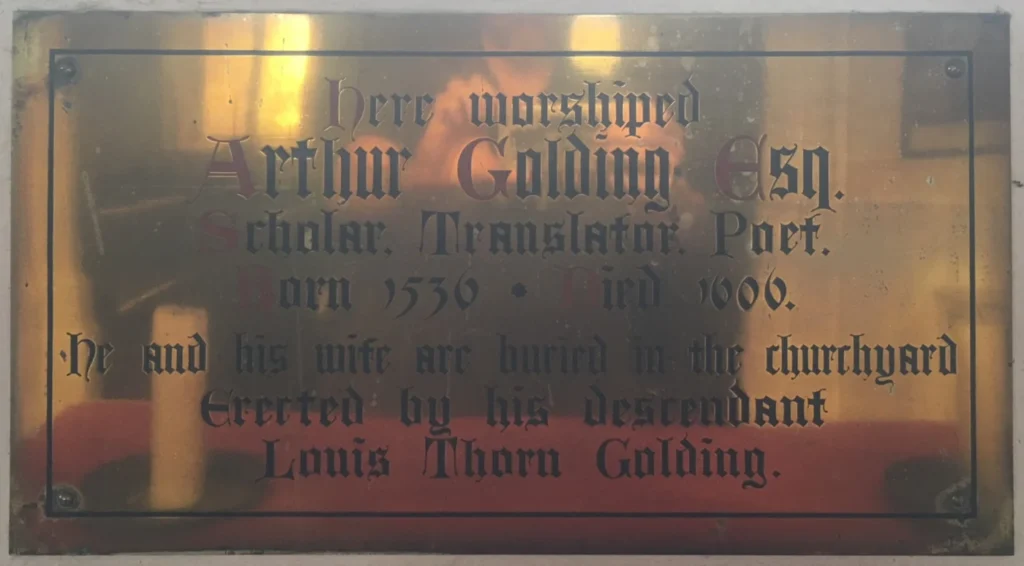
Arthur Golding (c. 1536–1606) translated classical and religious works for English readers during the reign of Elizabeth I. His English Ovid is a particularly important example of the movement of ancient literature into Renaissance vernacular writing.
For Golding’s own introductory writing, read Golding’s dedication and preface.
Life and literary career
Golding came from an Essex landowning family and had connections to the household of Edward de Vere, seventeenth Earl of Oxford, through his half-sister Margaret. He worked in the service of influential patrons, among them William Cecil. His career involved far more than classical poetry: he translated history, philosophy and Protestant religious writing. The nineteenth-century biographer Sidney Lee describes his relations with Sir Philip Sidney and his completion of a religious translation that Sidney had begun.
Ovid and the English Renaissance
Golding’s best-known undertaking is the verse translation of Ovid’s Metamorphoses, completed in 1567. Its long rhyming lines, often called fourteeners, give the mythological narrative a distinctive English rhythm. The stories of gods, mortals and transformations brought classical material into a form that English poets, playwrights and readers could explore. Golding’s preface is also important in its own right: it shows how a translator could situate pagan stories in the intellectual and religious setting of the sixteenth century.
Selected works
- The Commentaries of Caesar (1565), translation of Julius Caesar.
- The Metamorphoses of Ovid (1567), complete English verse translation.
- Abraham’s Sacrifice, translation of Theodore Beza’s drama (1575).
- The Work of Seneca concerning Benefiting, translation of De Beneficiis (1578).
- A Work concerning the Truth of the Christian Religion, completing Sir Philip Sidney’s translation of Philippe de Mornay (published 1587; see later editions).
These works reveal the breadth of Golding’s interests: Roman history, classical mythology, moral philosophy, drama and theology. Readers comparing his translations should take account of differences in publication dates, spelling and editorial practice across editions.
Bibliographical resources
For an extended historical account and list of publications, consult Sidney Lee’s entry Golding, Arthur, in the Dictionary of National Biography (volume 22). For a later scholarly treatment, see the Oxford Dictionary of National Biography entry.
This biographical entry is an original editorial overview drawing on historical and bibliographical sources, not a transcription of the 2002 essay that previously occupied this address.