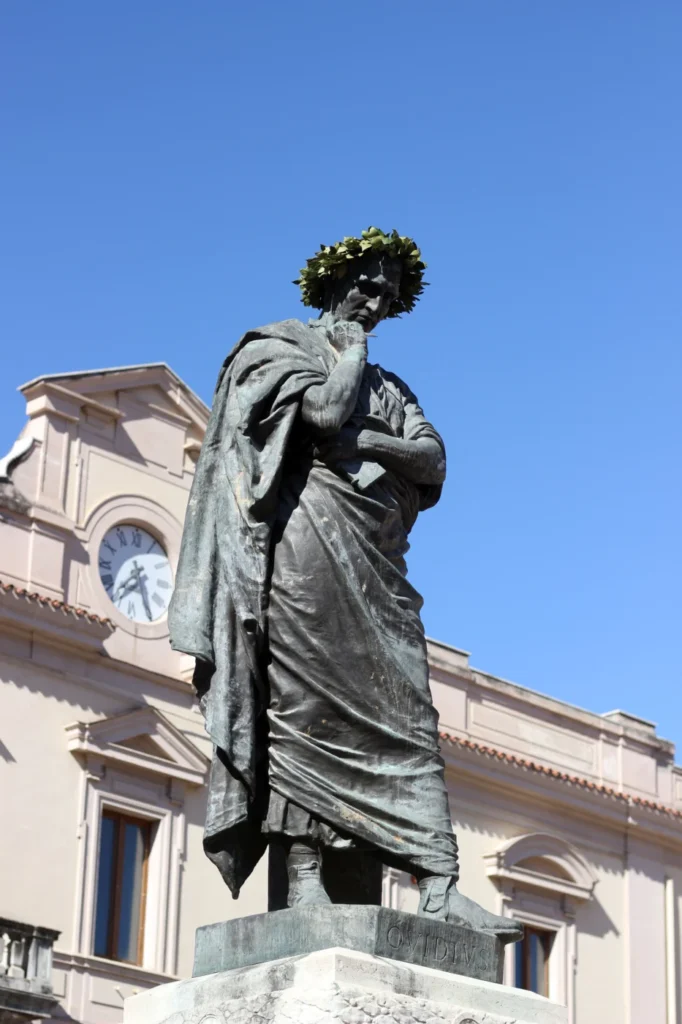
Classical mythology provided early modern writers with a collection of stories, characters and images that could be reshaped for new purposes. A tale of transformation might help a poet describe love, a goddess might become a character in a courtly play, and an ancient narrative might supply the framework of a tragedy. Elizabethan literature did not simply preserve classical stories; it actively reinterpreted them.
To begin with the translator’s own framing, read Golding’s dedication and preface.
Ovid and the power of translation
Ovid's Metamorphoses is an especially important source for studying these literary connections. Arthur Golding's English translation, completed in 1567, made the poem available in a distinctive vernacular form. A translation is a creative act as well as a means of access: rhythm, word choice and cultural references influence how the story is experienced by a new readership.
Readers of Golding can compare the translator's prefatory material with the narrative books. The preface offers a framework for approaching the stories, while the verse presents characters and transformations in their narrative settings. A reader need not assume that the translator's explanation exhausts the potential meanings of the poem.
From classical narratives to the stage
The story of Pyramus and Thisbe, told in Book IV of Ovid, offers an illustration of the adaptability of myth. It also appears in Shakespeare's A Midsummer Night's Dream as the subject of an amateur performance. The dramatic effect depends not only on the inherited story but on the manner in which the players perform it and the responses of the surrounding audience. A tragic narrative becomes material for comedy without losing all connection to its earlier form.
John Lyly's Endimion and Sapho and Phao offer another way of observing classical names and images in English drama. Rather than assuming that each character corresponds mechanically to an ancient model, readers can examine the function of mythological material within the play. Courtship, authority and desire can be explored through an imaginative setting that is neither simply ancient nor simply contemporary.
Mythology in poetry
A poet could expect some readers to recognise familiar myths while providing explanations for others. Thomas Watson's Hekatompathia is particularly valuable for studying this process because its literary design brings verse into contact with explanatory material and inherited poetic traditions. A mythological reference may supply an analogy, complicate a declaration of love or invite the reader to compare different literary sources.
These references should be interpreted in their local context. The same figure may have different functions in a translation, a poem and a theatrical performance. Writers also encountered classical narratives through multiple routes, including education, other literary works and visual culture. A resemblance alone does not establish which source a particular writer used.
Following a story across forms
A productive exercise is to select one myth and compare its presentation across different works. Note which details remain, which disappear and which new features become significant. The comparison shows how Renaissance writers transformed inherited material into new literature. Classical mythology is therefore not just a catalogue of names: it is a way of understanding the creative relationship between reading, translation and dramatic invention.