Late in Shakespeare’s Henry VIII, a courtier is asked where he has left the king. “I left him at primero with the Duke of Suffolk,” comes the reply. It’s a throwaway line. Nobody in the audience needed it explained. Primero was the fashionable card game of the Tudor court, and the picture of a king passing the evening over a hand of cards would have felt perfectly ordinary.
Small moments like that make a deck of cards a surprisingly useful window into England under Elizabeth I, who reigned from 1558 to 1603. A game could fill a winter evening. It could mark friendship between neighbours or rank between a lord and his guests. It could start a quarrel, empty a purse or hand a playwright a ready-made metaphor. To follow the cards is to follow people through their houses, their taverns and their imaginations.
Who had time to play?
Leisure in Elizabethan England depended heavily on who you were. A prosperous household had space for guests, servants to clear the table and long evenings to fill. An artisan’s free time was squeezed between long working days, Sunday church and the endless chores of keeping a home running. A farm labourer might have very little time at all outside holidays and feast days.
Cards were only one option among many. People played bowls, tennis and football. They danced, sang and listened to music. They watched bear-baiting on the south bank of the Thames, and from the 1570s onward they crowded into the new public playhouses. Seasonal festivals brought their own games and revels.
What made cards appealing was how little they needed. No field, no court, no special building. A pack could be carried in a pocket and brought out in a kitchen, a tavern or an inn on the road. Court records and literary references make clear that card playing was a familiar part of life by the late sixteenth century. Our essay on card playing in social life looks more closely at where and how these games fit into everyday routines.
What they played
Primero was the great prestige game. Players held four cards and tried to make particular combinations, with plenty of bluffing along the way. In The Merry Wives of Windsor, Falstaff grumbles that he never prospered since he forswore himself at primero, a joke that only works if the audience knew the game.
Noddy was a humbler game of counting and pegging, often seen as an ancestor of cribbage, which appeared in the following century. Gleek, a game for three players, also turns up in period writing. Trump and ruff were played too, early cousins of the trick-taking games that later grew into whist.
A word of caution belongs here. A game’s name surviving in a play or a diary doesn’t tell us exactly how it was played. Many rule books were written decades later, and rules drift. What a seventeenth-century manual calls primero may not match what Elizabeth’s courtiers actually did at the table.
The deck as an object
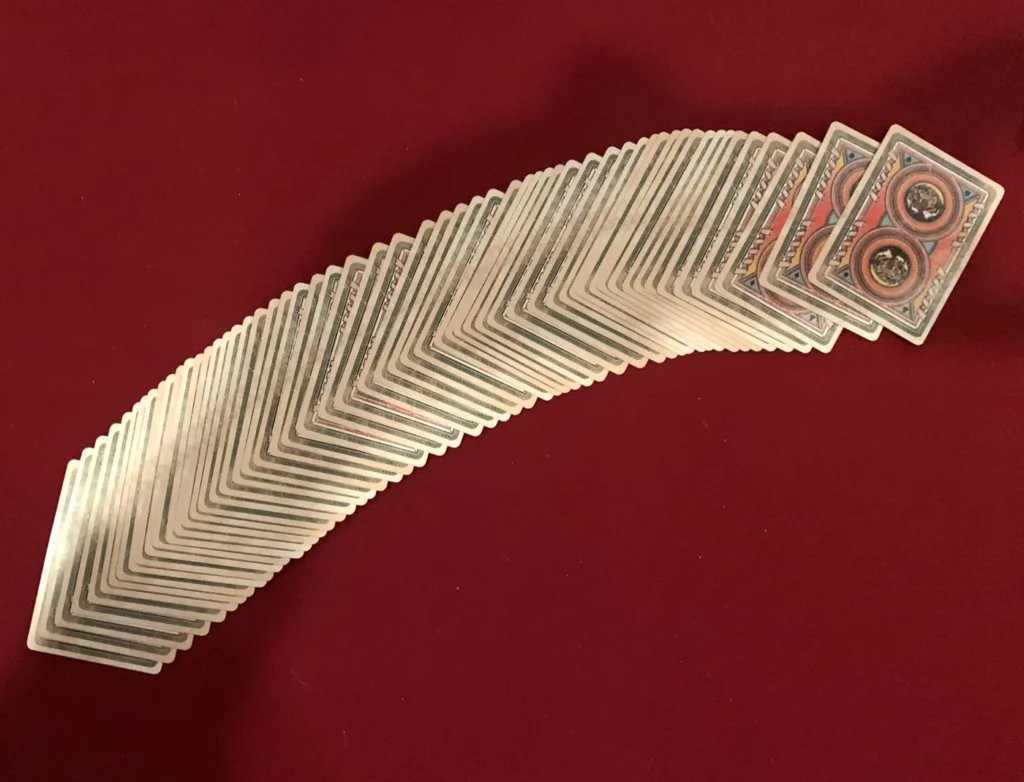
Renaissance playing cards were not one thing. Luxury decks could be hand-painted works of art, kept carefully and passed down. Ordinary packs were cheap printed sheets, cut, pasted onto card and used until they fell apart. Most of what survives belongs to the first group, for the obvious reason that nobody thought to preserve the battered pack from the kitchen.
That creates a trap for historians. A beautiful surviving deck shows what wealthy people valued. It doesn’t show what most households actually held in their hands. The court cards familiar in England, the kings, queens and knaves, largely came from designs made in France, especially in Rouen, and English printers copied and adapted them for generations.
Cards were also a business, and a political one. In 1598 Elizabeth granted a courtier named Edward Darcy a monopoly on the import and sale of playing cards. When a London haberdasher went on selling cards anyway, the dispute ended up in court. The case of Darcy v Allen, decided in 1602, became one of the founding cases in English law against monopolies. A pack of cards, of all things, helped shape the law of free trade.
The Metropolitan Museum of Art’s exhibition The World in Play, devoted to luxury cards from 1430 to 1540, is a good place to see the earlier visual traditions these packs grew out of. When looking at any surviving deck, it’s worth noticing the paper, the pigments, the symbols, the figures and any signs of wear. Each one tells you something about who made it and who used it. Our companion essay on the changing visual language of playing cards traces those designs over time.
Critics and restrictions
Not everyone approved. Playing for money could lead to debt, quarrels and the occasional knife drawn over a disputed hand. Preachers and moralists warned that cards encouraged idleness and worse. The authorities had their own reasons for concern. Henry VIII’s Unlawful Games Act of 1541 had already restricted many games for ordinary people, partly to keep them practising archery instead, and it stayed on the books long after Elizabeth came to the throne.
Yet it’s important not to take the critics at their word. Not every game was played for stakes. Families played for pins or for nothing at all. A sermon thundering against cards tells us what one preacher feared, not what most people were doing on a Tuesday night. Historians have to keep three things separate. Ordinary social play, play for money, and the official efforts to control both. A law that bans something is evidence that the thing existed and that someone worried about it. It isn’t proof that the ban worked.
What the stage can tell us
Playwrights loved cards because audiences already understood them. Shuffling, dealing, holding a strong hand and losing everything in a single turn all made easy shorthand for fortune, deception and sudden reversal. In Antony and Cleopatra, the defeated Antony accuses Cleopatra of having packed cards with Caesar, meaning she cheated him by stacking the deck in his rival’s favour. One phrase carries a whole charge of betrayal.
Drama is slippery evidence, though. A comedy might exaggerate a character’s addiction to cards for laughs. A tragedy might use a game as a symbol of fate. Neither is a record of how real people spent their time. A scene shows how a writer and an audience imagined play, which is valuable in its own way, but it isn’t a census. The Folger Shakespeare Library’s guide to games and Shakespeare is a helpful place to explore how these references work across the plays.
Thomas Nashe’s Summer’s Last Will and Testament, first performed in 1592, is another rich source. Built around the passing of the seasons, it dramatises the feasts and recreations of the year, and shows how closely leisure was tied to the calendar. For more on the rhythm of the warmer months, the Folger’s Summertime in Elizabethan England answers some common questions.
From then to now
The language of cards has never really left English. We still talk about holding all the cards, playing a hand close to the chest, putting our cards on the table or having an ace up our sleeve. Those phrases carry the same sense of chance, rank and reversal that Elizabethan playwrights relied on.
Some readers enjoy comparing Elizabethan games with modern card games, from bridge and rummy to digital versions played on a phone. Those comparisons can be fun, and they show how imagery lasts while its meaning changes. But a shared symbol isn’t proof of descent. A king on a modern card doesn’t tell us how primero was played in 1590, and today’s games shouldn’t be read back into the past. Our essay on literary treatments of chance and fortune explores how writers of the period thought about luck and fate.
Reading the cards
Studying Elizabethan pastimes isn’t about rebuilding one universal leisure culture. There wasn’t one. A courtier at primero, an apprentice with a greasy pack in a tavern and a family playing for pins by the fire all lived different versions of the same habit.
What the cards offer instead is a way of seeing how objects, social life and imagination fed each other. A deck in a museum case, a line in a play and a dusty court record each tell part of the story. Put together carefully, they let us glimpse a world where a king could be found at cards with his friends, and an audience would nod, because they knew exactly what that looked like.