Characters in Elizabethan drama often discover that their confidence in the future is misplaced. A political position can collapse, an apparently secure affection can become a source of suffering, and a deliberate plan can produce an unforeseen result. Writers used several overlapping ideas to interpret such events: chance, Fortune, fate and providence. These are not exact synonyms, and distinguishing them helps clarify what a play is doing.
For the appearance of personified powers on stage, read the opening of Soliman and Perseda.
Fortune as an image and a character
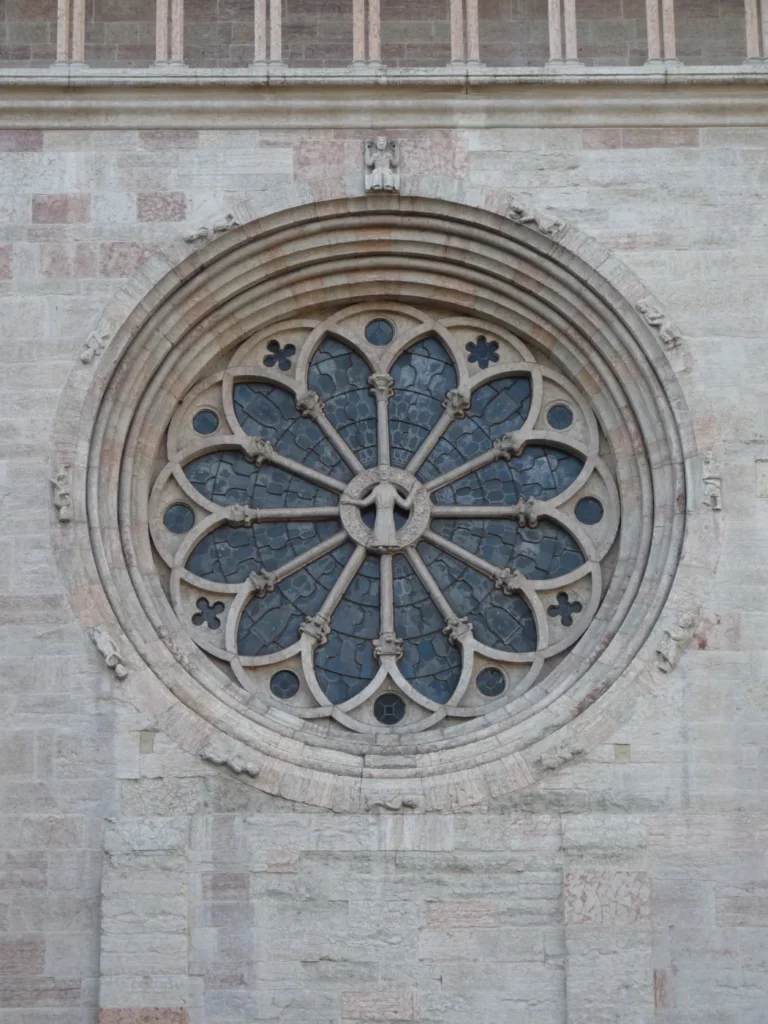
The wheel of Fortune was familiar in medieval and Renaissance visual culture. The movement of the wheel expresses the instability of worldly position: ascent is followed by the possibility of descent. A person shown near the top has no guarantee of remaining there. The image does not require every writer to adopt the same explanation of the universe.
In Soliman and Perseda, Fortune is more than a casual metaphor. Love, Fortune and Death appear as personified powers in the dramatic framing. Their presence invites the spectator to consider competing explanations for the events that follow. It is useful to examine how the figures claim influence before assuming that the characters within the story are powerless. Their decisions are still central to the dramatic action.
Tragedy and the limits of knowledge
The Spanish Tragedy offers a different perspective on suffering and delayed justice. The audience knows more than some of the characters, and this difference in knowledge changes how choices and consequences are experienced. The opening presence of Andrea and Revenge establishes a framework that makes the subsequent events part of a larger dramatic pattern. It does not remove the need to examine motives, errors and responsibilities.
A reversal can therefore be produced by a character's action, by circumstances outside that character's control, or by the structure of the play itself. Readers should avoid treating every unexpected event as an example of Fortune in a strict allegorical sense. The language of the passage and the role it plays in the action provide stronger evidence than a general thematic resemblance.
Providence, fate and responsibility
Early modern readers could encounter Christian accounts of divine order alongside classical stories of destiny and Fortune. A play might place those ideas in tension without offering a final philosophical solution. Different characters may speak from incompatible viewpoints, and an actor's words are not automatically a declaration of the playwright's personal beliefs.
The dramatic use of uncertainty also differs from mathematical probability. Images of dice, games or the turn of a wheel express the vulnerability of human expectations. They cannot be read as claims about predictable outcomes in actual games. Their value in literature lies in how they invite the audience to reflect on judgement, ambition and the limits of control.
A method for close reading
Begin by noting who speaks about Fortune and at what moment. Compare what the speaker knows with what the audience knows. Then examine whether the language is repeated, embodied by a personified figure or contradicted by the outcome. This approach reveals how the imagery of changing fortune contributes to dramatic form, rather than reducing the play to a single lesson about destiny.