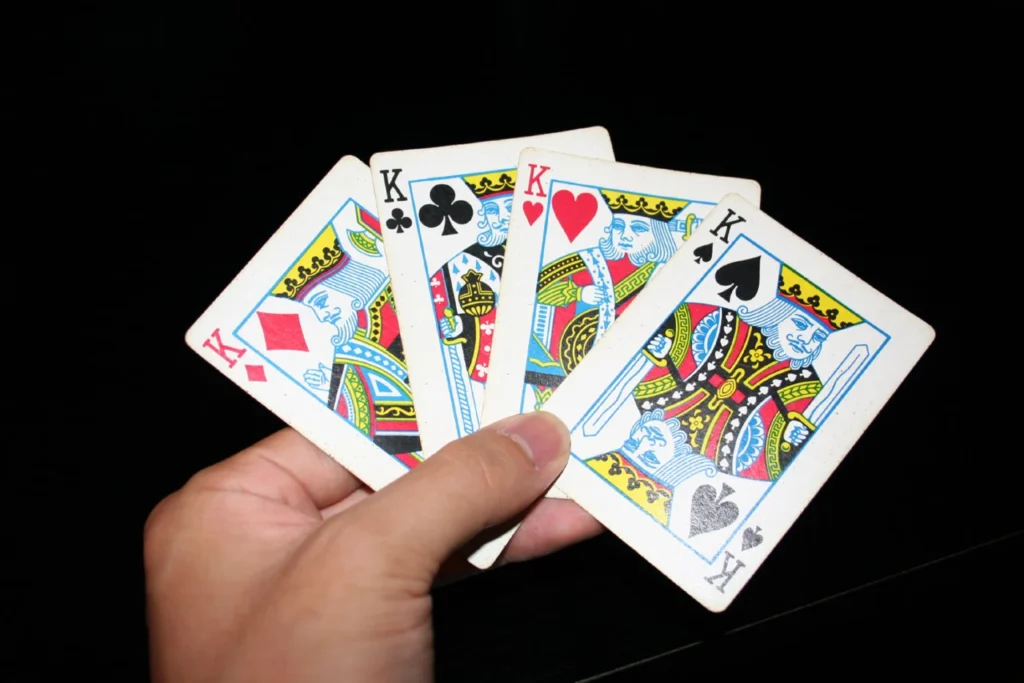
Playing cards are miniature systems of signs. Rank, suit and repeated design allow an observer to identify a card within a larger group. In literature, a reference to cards can borrow the language of those systems, using an ordinary object to suggest a complicated relationship between people, status and uncertainty. The interpretation of such imagery requires attention to both historical objects and the immediate context of a passage.
For the material context of card imagery, read historical card designs and suit systems.
The visible language of rank
Court figures on playing cards present kings and other ranked characters in recognisable visual forms. This does not mean that all card packs represent actual monarchs or that every figure has a fixed allegorical meaning. The early European decks preserved in museums demonstrate how widely imagery and hierarchies could differ. Their diversity is a warning against interpreting a Renaissance text through the conventions of a single modern pack.
The dramatic representation of rank is a separate but related subject. In a history play, characters may negotiate loyalty, inheritance and authority through speech and action. The visibility of kingship on a card provides a comparison with the visual presentation of kingship on stage. It is a comparison, not proof that a given play uses a card-based allegory.
Wordplay and competing meanings
A word such as suit can refer to clothing, an appeal, a courtship or a set of cards, depending on its setting. A reader encountering a possible pun should ask which senses are supported by surrounding words and by the action. The Folger's guide to the language of As You Like It shows how much can be lost when a historical expression is understood only through its most familiar modern meaning.
The same care is needed with expressions involving hands, dealing and fortune. Some are connected with games in particular contexts, while others have independent histories. Modern idioms may postdate the play in question. The appearance of a word associated with cards is a reason to investigate its period usage, not a sufficient demonstration that cards are the subject of the passage.
Material objects and literary interpretation
There is also a difference between an object mentioned in a literary work and an object actually used in performance. A script might refer to a game without requiring the actors to produce a pack of cards. Conversely, a director might use cards in a modern production to suggest social tension. That modern staging choice may be effective without constituting evidence about the original production.
Game imagery can help express uncertainty, concealment or competition. Yet the same play may represent chance through entirely different images, including Fortune's wheel. Rather than imposing an elaborate symbolic system on a text, readers can compare repeated motifs and evaluate the evidence for each proposed interpretation.
How to test an interpretation
Record the wording, identify its speaker, and examine how it contributes to the scene. Consult a historical dictionary or a scholarly edition where the meaning is uncertain. Compare period objects only after establishing their date and provenance. These steps allow material culture to enrich close reading without substituting a modern system of associations for the complexity of Renaissance literature.