The Elizabethan world of entertainment extended far beyond the playhouse. A calendar of feast days, public gatherings, household celebrations and local customs gave recreation different forms. The places in which people met mattered as much as the activities they enjoyed, for each setting created its own expectations about behaviour and participation.
For a primary literary example, read Nashe’s dramatic treatment of the passing seasons.
Taverns, inns and alehouses
Public houses served more than one purpose. They offered refreshment and opportunities for conversation; inns could also provide accommodation and services for travellers. The terms used to describe these establishments were not always interchangeable, and regulation differed over time and between localities. The Folger Shakespeare Library's study of tavern tokens illustrates how later surviving objects help historians investigate the practical world of hospitality and commerce.
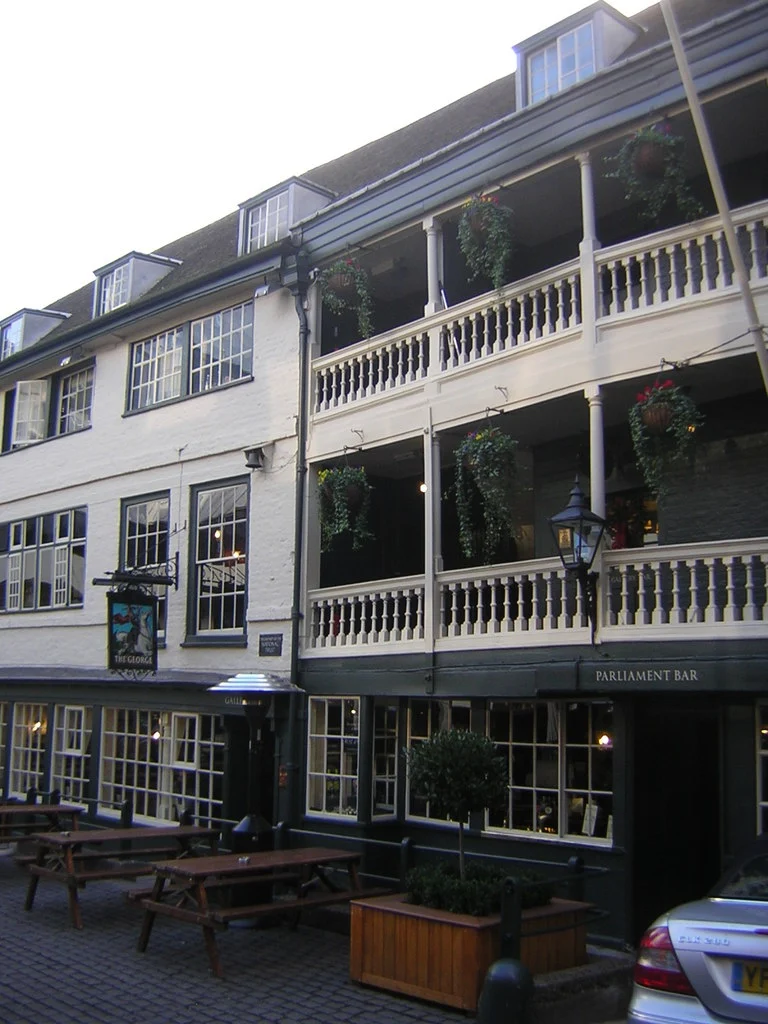
The George Inn in Southwark is a useful site for imagining the connection between public houses and London's theatrical districts. The surviving building is later than Elizabeth's reign, however. A modern photograph of the inn is an illustration of the longer history of such establishments, not a photograph of an Elizabethan building in its original state. Architectural evidence has to be dated before it can support historical claims.
The rhythm of the calendar
Seasonal celebrations offered occasions for communal music, dancing and performance. The Reformation altered religious practices and the organisation of some festivities, but local customs did not disappear uniformly. Festivity could be a source of belonging or a focus of disputes about appropriate conduct. In the Elizabethan theatre, references to festive behaviour drew upon an audience's understanding of these social rhythms.
Thomas Nashe's Summer's Last Will and Testament is a particularly suggestive example. Its personification of the seasons makes the changing year into dramatic action. The play does not provide a literal calendar of village customs; it makes seasonal imagery part of an imagined argument about life, hospitality and mortality. This is one reason literary texts can contribute to the study of recreation without being mistaken for documentary records.
The audience and the public stage
Playgoing created another form of shared recreation. It brought spectators together in a commercial venue where speech, music, costume and action were experienced collectively. Theatrical representation could draw on settings and customs familiar to its audience, including feasts, hospitality, quarrels and festive disorder. These familiar elements could then be transformed into comedy or tragedy.
It is important to remember that not everyone had the same access to leisure. Work, distance, cost and household responsibilities affected participation. Evidence of an event in London cannot necessarily describe conditions in a rural community. Nor does an official objection prove that a practice was universally observed.
Reading spaces and celebrations together
The history of recreation becomes clearer when we ask where a gathering took place, who organised it, who could attend and what obligations surrounded it. Taverns and festivals illuminate the networks of relationships within which entertainment occurred. The plays of the period turn those relationships into stories, offering another way to investigate the values, tensions and imaginative resources of Renaissance England.